I wish everyone could attend a Bible dedication in their lifetime! We've been to 2 of them and the day (or perhaps a week of festivities) is full of energy and excitement! There is feasting, dancing, singing and many speeches. It's a culmination of a lot of years of hard work and perseverance and a time when the translators say, "Yes, it's worth it all!" We were able to hand out Bibles at one dedication and what a privilege it was! People were so thankful and many gave me bilums (string bags) as a way of saying thanks. Their excitement and enthusiasm made me appreciate God's Word in English all the more. What would it be like to not have God's Word in my own language?
Papua New Guinea:
Kuman New Testament
Folopa New Testament and I'll include this short video of an interview with the translator on the day of the dedication.
Lote New Testament
West Kewa New Testament
Vanuatu
North Tanna New Testament
Solomon Islands
Arosi Dedication
Thursday, December 30, 2010


Tuesday, December 28, 2010
Bible Dedications planned for 2011 -12 in PNG
15 Bible Dedications are being planned for 2011-12! I see each one as a testimony of God's faithfulness through the years in enabling the translators to keep going and providing all that was needed to get the work done. Let's pray that nothing will keep these dedications from taking place and that people will know God through reading His Word in their own language!
Language Date Province
Nehan Jan 15, 2011 Bougainville
Ata Apr 2011 West New Britain
Saveeng-Tuam (Mutu) Apr 2011 Morobe
Saveeng-Oov (Mutu) Apr 2011 Morobe
Madak New Ireland
Agarabi May 22, 2011 Eastern Highlands
Bola June 25, 2011 New Britain
Bariai Aug 2012 New Britain
Kuni-Boazi Western
Arop-Lokep 2011, 2014 Madang
Marik Madang
Maiwa 2012 Milne Bay
Ogea (BTA) Madang
Uri Morobe
Konai Western
Language Date Province
Nehan Jan 15, 2011 Bougainville
Ata Apr 2011 West New Britain
Saveeng-Tuam (Mutu) Apr 2011 Morobe
Saveeng-Oov (Mutu) Apr 2011 Morobe
Madak New Ireland
Agarabi May 22, 2011 Eastern Highlands
Bola June 25, 2011 New Britain
Bariai Aug 2012 New Britain
Kuni-Boazi Western
Arop-Lokep 2011, 2014 Madang
Marik Madang
Maiwa 2012 Milne Bay
Ogea (BTA) Madang
Uri Morobe
Konai Western
Tuesday, December 14, 2010
Update on Scripture Engagement in the Pacific
I was encouraged to read the following report from Mick Bandy, the Scripture Use coordinator for the Pacific area. SALT stands for Scripture Application and Leadership Training and it's designed to help and encourage people to read the Bible. You can read more about SALT here and Scripture Use here.
Yopno SALT course, Morebe Province, PNG, August 2010

The Yopno SALT course ran from August 9-22, immediately after the dedication of the Yopno New Testament on August 8, 2010. More than 200 participants were enrolled in the course, and many of them had purchased the Yopno New Testament and Psalms at the dedication. They were eager to attend the SALT course which began two days later. In fact, so many people wanted to hear the lessons that there was not enough room for them in the building. Some sat outside, listening intently to the teaching through the thatched walls.
Scripure Use Principles and Methods Course, PNG
Sept. 13-17, 2010

On the 13-15th and 17th September, the SIL-PNG Scripture Use Department hosted a Scripture Use Principles and Methods course at SIL’s new training centre. The course objectives were to familiarize participants with the resources available to run a local or regional Scripture Use course, as well as to enable them to lead and teach an SU workshop in their language areas. Topics included in this workshop were "Barriers" presented by Lizzie Meyer; "Culture in the Plan of God" presented by Amy Lindstrom; "Language in the Plan of God" presented by Danny DeLoach; "Key Terms and Translation Principles" presented by Joan Farr; "Multilanguage Churches" presented by Danny DeLoach; "SU in the Arts" presented by Patty Van der Meer; and "Storytelling" presented by Cindy Walker. The book "Translating the Bible Into Action" was the resource book made available for participants to purchase. "Yusim Baibel" was also given to the Papua New Guinea participants as a supplemental book to go in connection with "Translating the Bible Into Action." The photo above is an interactive exercise called "gatekeepers and clan leaders."
Solomon Islands Pisin SALT course, Honiara, Sept. 6-17, 2010

Twenty-four pastors and church leaders from five different language groups received certificates at the Solomon Islands Pisin SALT course, which ran from September 6-17, 2010, in Honiara, Guadalcanal.
Solomon Islands SALT Instructors' Training Course, Honiara, September 20-24, 2010

After the SALT course, a SALT Instructors’ Training course was conducted for 18 pastors and church leaders from 5 language groups. These leaders are now certified to teach the SALT course in their own language group in the Solomon Islands.
New Ireland Province Scripture Use Conference, PNG, September 27 - October 1, 2010

Church leaders from all over New Ireland Province gathered under the banner "Mother-tongue Scripture Conference: God's Word in mother-tongue is truly sweet!" This conference was the first regional Scripture Use conference planned as a follow-up to the national level Scripture Use conference held at Ukarumpa in January 2010. A few highlights of the New Ireland Province Scripture Use conference were: All church denominations present made concrete commitments to promote the translation and use of vernacular Scriptures in their congregations. A particular encouragement was the high level of enthusiasm and support from the many top-level regional Catholic leaders who attended, including the Bishop from the area. At the end of the conference all participants affirmed a ‘declaration’, attesting to the central role of mother-tongue Scriptures in the life of the church. The sweet spirit of unity expressed and experienced by the diverse denominations present was savored by all.
Tok Ples in Ministry Awareness Visits in Rabaul/Kokopo Area,PNG, October 4-7
 From 4 to 7 October 2010 Steven Hong and Danny DeLoach visited several church training schools in the Rabaul/Kokopo area to promote awareness of the Tok Ples in Ministry Course. (Note: This course also goes by the name Vernacular in Ministry course, but the name has been changed for use outside of SIL.) The Rabaul area is a major center of church training institutions. Danny DeLoach reports: "We were received warmly be each school we visited. We left Tok Ples in Ministry resources (including lesson plans and brochures) with the Regional Centre manager." Highlights included: The leaders of the SDA school, Sonoma Adventist College, were very interested and excited about the Tok Ples in Ministry curriculum. They were ready for someone to come teach once a week for several weeks right away. The principal of Sonoma is a Nyndrou speaker from Manus Island. He says that he reads his Tok Ples (vernacular) Bible regularly and even refers to it when some passages are not clear to him in English. Each of the other three schools visited clearly expressed their desire to have Tok Ples in Ministry courses.
Hymnbook Production Workshop
Ligga, New Ireland Province, October 4-15

A Hymnbook Production Workshop was held at Ligga (near Kavieng) for three language groups of Northern New Ireland Province in PNG. This program was initiated by Steven and Holly Hong in cooperation with the United Church of New Ireland. Tomas and Riikka-Maria Kolkka facilitated the workshop, which had participants from the Tigak, Tiang and Kara-Luvurua languages. The oldest man in the picture above, Alison, has translated 200 hymns into the Tigak language!
SMBG (Sabi Mowa Blanga Godwei) course
Northern Territory, Australia, November 3-12, 2010

Pacific S.A.L.T. material was adapted and translated into the Kriol language; and Margaret Mickan, Lisa Detleftsen, John Armstrong and Rachel Borneman taught the SMBG (Sabi Mowa Blanga Godwei) course from November 3-12, 2010. Rachel reports highlights of the course include: "Reading the Kriol Bible ‘mijamet’ (i.e. together) and helping them (& us) grow stronger in their walk with the Lord; having about 10 faithful ladies that came more than eighty percent of the time. Some mates of John came a few times plus others; using a variety in the teaching styles – i.e. posters, worksheets, dramas, questions, etc. to present the message in Kriol; knowing most of the language, most of us could teach directly in Kriol and could adapt the worksheets to suit what we were teaching; Lisa’s inspiration in printing a children’s colouring-in sheet with each teaching for the kids that were coming; helping to encourage the indigenous folk to share the teachings at fellowship and out to the communities and share even at a card game! Great to have John continue to be there. Please pray as he continues to teach the Sin topics. As we got through the first secion ‘Hu God en hau im laigim pipul’ i.e. God and how he loves his people."
Iyo SALT course, Madang Province, PNG
November 12 - 27, 2010
 Approximately 80 people attended the Iyo SALT course everyday, with 48 receiving certificates at the end of the course. The translation of the Iyo New Testament was facilitated by Paul and Jennie Minter.
SALT Instructors' Training Course, Ukarumpa, PNG, November 29 - December 4, 2010
Mick Bandy, Palmer Bandy, Marjan Sikkema, Carol Saferita, Fred Igami and Abra Noso facilitated this SALT Instructors' Training Course in Ukarumpa Training Center, PNG. At the graduation ceremony on December 4, 2010, nineteen new SALT instructors were recognized as Certified SALT Instructors. These participants will now join SALT teams throughout the nation of Papua New Guinea and the Pacific to encourage the study of God's Word in their own heart languages. "The Power of God’s Word … in every language … in every heart."
Future SU events planned during 2011 in the Pacific Area:
Trauma Healing Workshop in PNG scheduled for July 2011 - We will be hosting the very first Aiyura Valley Trauma Healing Workshop next July at our new training centre. A total of forty church pastors and church leaders (men and women) will be invited to attend this workshop which will train them on the area of trauma: the effects of trauma, how to grieve well and what the process of grief looks like, how to help women who have been raped and children of HIV AIDS who are left behind, and how to prepare for future crises and trauma. This workshop is a HUGE tool that God is giving us in order to equip our church pastors and leaders in the valley and we ask for financial support to make it possible, as well as prayer cover and spiritual wisdom for our teaching staff.
Various Regional Scripture Use Workshops are scheduled throughout Papua New Guinea in 2011.
SALT Courses in 2011
Jan 2011 -- Numangang SALT -- Jan 10-22
Feb 2011 -- Aiyugam SALT – Jan 31 – Feb 13
Feb 2011 – Tabo SALT - TBD,
March 2011 – Barum-Mindik SITC - TBD
April 2011 – Miniafia SALT - April 4-16
May 2011 – Sursurunga SALT - May 2-15
June 2011 – Bola SALT - June 24 – July 12
July 2011 – Ata SALT - TBD
Aug 2011 – Abau SALT course - Aug 22 – Sept 3
Sept 2011 – Solomon Islands SALT - Sept 19-30
*TBD = To be determined
Want to be involved? Contact me.
Yopno SALT course, Morebe Province, PNG, August 2010

The Yopno SALT course ran from August 9-22, immediately after the dedication of the Yopno New Testament on August 8, 2010. More than 200 participants were enrolled in the course, and many of them had purchased the Yopno New Testament and Psalms at the dedication. They were eager to attend the SALT course which began two days later. In fact, so many people wanted to hear the lessons that there was not enough room for them in the building. Some sat outside, listening intently to the teaching through the thatched walls.
Scripure Use Principles and Methods Course, PNG
Sept. 13-17, 2010

On the 13-15th and 17th September, the SIL-PNG Scripture Use Department hosted a Scripture Use Principles and Methods course at SIL’s new training centre. The course objectives were to familiarize participants with the resources available to run a local or regional Scripture Use course, as well as to enable them to lead and teach an SU workshop in their language areas. Topics included in this workshop were "Barriers" presented by Lizzie Meyer; "Culture in the Plan of God" presented by Amy Lindstrom; "Language in the Plan of God" presented by Danny DeLoach; "Key Terms and Translation Principles" presented by Joan Farr; "Multilanguage Churches" presented by Danny DeLoach; "SU in the Arts" presented by Patty Van der Meer; and "Storytelling" presented by Cindy Walker. The book "Translating the Bible Into Action" was the resource book made available for participants to purchase. "Yusim Baibel" was also given to the Papua New Guinea participants as a supplemental book to go in connection with "Translating the Bible Into Action." The photo above is an interactive exercise called "gatekeepers and clan leaders."
Solomon Islands Pisin SALT course, Honiara, Sept. 6-17, 2010

Twenty-four pastors and church leaders from five different language groups received certificates at the Solomon Islands Pisin SALT course, which ran from September 6-17, 2010, in Honiara, Guadalcanal.
Solomon Islands SALT Instructors' Training Course, Honiara, September 20-24, 2010

After the SALT course, a SALT Instructors’ Training course was conducted for 18 pastors and church leaders from 5 language groups. These leaders are now certified to teach the SALT course in their own language group in the Solomon Islands.
New Ireland Province Scripture Use Conference, PNG, September 27 - October 1, 2010

Church leaders from all over New Ireland Province gathered under the banner "Mother-tongue Scripture Conference: God's Word in mother-tongue is truly sweet!" This conference was the first regional Scripture Use conference planned as a follow-up to the national level Scripture Use conference held at Ukarumpa in January 2010. A few highlights of the New Ireland Province Scripture Use conference were: All church denominations present made concrete commitments to promote the translation and use of vernacular Scriptures in their congregations. A particular encouragement was the high level of enthusiasm and support from the many top-level regional Catholic leaders who attended, including the Bishop from the area. At the end of the conference all participants affirmed a ‘declaration’, attesting to the central role of mother-tongue Scriptures in the life of the church. The sweet spirit of unity expressed and experienced by the diverse denominations present was savored by all.
Tok Ples in Ministry Awareness Visits in Rabaul/Kokopo Area,PNG, October 4-7

Hymnbook Production Workshop
Ligga, New Ireland Province, October 4-15

A Hymnbook Production Workshop was held at Ligga (near Kavieng) for three language groups of Northern New Ireland Province in PNG. This program was initiated by Steven and Holly Hong in cooperation with the United Church of New Ireland. Tomas and Riikka-Maria Kolkka facilitated the workshop, which had participants from the Tigak, Tiang and Kara-Luvurua languages. The oldest man in the picture above, Alison, has translated 200 hymns into the Tigak language!
SMBG (Sabi Mowa Blanga Godwei) course
Northern Territory, Australia, November 3-12, 2010

Pacific S.A.L.T. material was adapted and translated into the Kriol language; and Margaret Mickan, Lisa Detleftsen, John Armstrong and Rachel Borneman taught the SMBG (Sabi Mowa Blanga Godwei) course from November 3-12, 2010. Rachel reports highlights of the course include: "Reading the Kriol Bible ‘mijamet’ (i.e. together) and helping them (& us) grow stronger in their walk with the Lord; having about 10 faithful ladies that came more than eighty percent of the time. Some mates of John came a few times plus others; using a variety in the teaching styles – i.e. posters, worksheets, dramas, questions, etc. to present the message in Kriol; knowing most of the language, most of us could teach directly in Kriol and could adapt the worksheets to suit what we were teaching; Lisa’s inspiration in printing a children’s colouring-in sheet with each teaching for the kids that were coming; helping to encourage the indigenous folk to share the teachings at fellowship and out to the communities and share even at a card game! Great to have John continue to be there. Please pray as he continues to teach the Sin topics. As we got through the first secion ‘Hu God en hau im laigim pipul’ i.e. God and how he loves his people."
Iyo SALT course, Madang Province, PNG
November 12 - 27, 2010

SALT Instructors' Training Course, Ukarumpa, PNG, November 29 - December 4, 2010
 |
Future SU events planned during 2011 in the Pacific Area:
Trauma Healing Workshop in PNG scheduled for July 2011 - We will be hosting the very first Aiyura Valley Trauma Healing Workshop next July at our new training centre. A total of forty church pastors and church leaders (men and women) will be invited to attend this workshop which will train them on the area of trauma: the effects of trauma, how to grieve well and what the process of grief looks like, how to help women who have been raped and children of HIV AIDS who are left behind, and how to prepare for future crises and trauma. This workshop is a HUGE tool that God is giving us in order to equip our church pastors and leaders in the valley and we ask for financial support to make it possible, as well as prayer cover and spiritual wisdom for our teaching staff.
Various Regional Scripture Use Workshops are scheduled throughout Papua New Guinea in 2011.
SALT Courses in 2011
Jan 2011 -- Numangang SALT -- Jan 10-22
Feb 2011 -- Aiyugam SALT – Jan 31 – Feb 13
Feb 2011 – Tabo SALT - TBD,
March 2011 – Barum-Mindik SITC - TBD
April 2011 – Miniafia SALT - April 4-16
May 2011 – Sursurunga SALT - May 2-15
June 2011 – Bola SALT - June 24 – July 12
July 2011 – Ata SALT - TBD
Aug 2011 – Abau SALT course - Aug 22 – Sept 3
Sept 2011 – Solomon Islands SALT - Sept 19-30
*TBD = To be determined
Want to be involved? Contact me.
Monday, November 8, 2010
PNG: Quotes from Scripture Use Conference
A Scripture Use Conference was recently held in New Ireland Province in Papua New Guinea. There were 25 languages represented: 7 have completed New Testaments and the 18 other languages are being translated. 46 people attended and there were 5 denominations represented!
 This is exciting to see different denominations coming together to declare the importance of Scripture in one's own language.
The participants wrote up this encouraging declaration during the conference::
• A Bible in one’s own language tastes sweet on our lips and cuts more deeply into our hearts, and it is essential for a vibrant church. (2 Timothy 3:16; Heb 4:12; Ezk 3:3; Jam 2:14-26)
• Christians must be able to understand the Bible clearly in order to grow in their faith. (Acts 8:30-31)
• For many people in our communities, the language that best helps them to understand the Bible is tok ples(their own language).
• We must start in our families, in our communities and go into all the world, reaching people in the language that they understand best. (Acts 1:8)
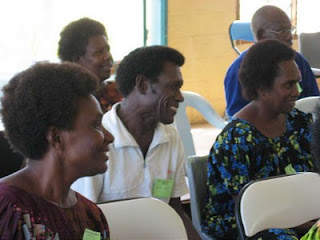 The following are paraphrased quotes from some of the participants:
Four Square Pastor:
This conference was like a clinic. We came with all kinds of sores. Or it is like we were a car running with out oil. When this conference started, I was not moved deeply in my heart, but at the end of this conference, I am moved deeply in my heart.
My denomination has a dream to reach New Ireland for Jesus. We’ve been wondering how to do that. Now I see that using mother-tongue Scriptures is a key strategy.
CLC Pastor:
I have seen God work deeply in my life. The cry of my heart has been to see the people in my church experience the same deep touch from God. I have lived both in a remote village and in town. I have seen the power of mother-tongue. I witnessed how the Word of God in mother-tongue deeply touches people. After this conference I am convicted about doing all I can to get the mother-tongue Scriptures to all the people. I feel challenged to start in my own family, promoting our own language.
Before this conference I did not experience much cooperation between the different denominations in our area. However, now I have a desire to work closely with other churches for this purpose of getting mother-tongue Scriptures out to everyone.
Seventh Day Adventist Participant:
Thank you to all the top leaders of the other denominations. I did not know you very well before this conference. But I have come to know you better and appreciate you during this conference.
I have a blended family. My first wife passed away in 2007. After that I married a woman who is from another language area. Her previous husband was from a third language. So, in my family now my children and step-children speak three different languages. I have been convicted through this conference to support and encourage each of my children to keep and maintain their own languages.
Bishop of Catholic Church (Bishop Ambrose Kiapseni):
 I feel encouraged that we can work together more closely. I had expected that there might be quarrels between us in this conference. However, we experienced the presence of God with us and we saw a great unity. Now I am convinced that we can work together, because of our experience this week. I do not want to forget what happened here this week. When we leave here and go back to our communities, let’s don’t go back to saying, “Oh, we are so different, we can’t work together”. Instead, let’s keep this spirit of unity. We have only one thing that keeps us together – that is Christ!
I have heard a saying, “There is no fast food in the Bible”. Think of a cow. There is a phrase we call “chewing the cud”. This refers to how a cow eats grass, and then just keeps on chewing on it for a long time. Someone may look at the cow doing this and say, “Oh, that is just a waste of time”. But think about what is happening. During that time that the cow is chewing the grass and gradually digesting it, over time it turns into creamy milk. That is how our time this week has been. We have to think over what we have heard this week from one another. We have to meditate about it to allow it to sink deeply into us.
Many people try to treat God’s Word like fast food or a snack. This leads to weak Christians and churches. Psalm 119:9-24 tells us how to place God’s Word at the center of our lives. As we study His Word and follow it, we will have strong Christians and healthy churches. We have to apply Scripture in our everyday lives. God’s Word is not meant to be fast food. If we approach it this way, how will it steer our lives?
Let’s all work together to see that all the people can have God’s Word. Encourage them not to see it as a snack food but to take it in deeply, meditate on it and receive strength from it.
Lamsong Parish Council Secretary (Blaise Lavenas):
We can’t just translate the Bible and not teach people how to use it. This would be like giving someone a car and not teaching them that it needs oil and water. In this case the person would just get in and drive it every day and the car would break down. In the same way, it is essential that we teach people how to use their Bibles.
Regional Catholic Leader (Father Bartholomew Marang):
When we don’t have a tok ples, it is like we don’t have roots and the wind can blow us around.
Four Square Pastor
Language is like a bridge for communication. Too often when the Scripture is in a language people do not understand well, it is like a bridge that is broken.
Wow, I was so encouraged to read this report and I thank God for what He is doing!

The participants wrote up this encouraging declaration during the conference::
• A Bible in one’s own language tastes sweet on our lips and cuts more deeply into our hearts, and it is essential for a vibrant church. (2 Timothy 3:16; Heb 4:12; Ezk 3:3; Jam 2:14-26)
• Christians must be able to understand the Bible clearly in order to grow in their faith. (Acts 8:30-31)
• For many people in our communities, the language that best helps them to understand the Bible is tok ples(their own language).
• We must start in our families, in our communities and go into all the world, reaching people in the language that they understand best. (Acts 1:8)

Four Square Pastor:
This conference was like a clinic. We came with all kinds of sores. Or it is like we were a car running with out oil. When this conference started, I was not moved deeply in my heart, but at the end of this conference, I am moved deeply in my heart.
My denomination has a dream to reach New Ireland for Jesus. We’ve been wondering how to do that. Now I see that using mother-tongue Scriptures is a key strategy.
CLC Pastor:
I have seen God work deeply in my life. The cry of my heart has been to see the people in my church experience the same deep touch from God. I have lived both in a remote village and in town. I have seen the power of mother-tongue. I witnessed how the Word of God in mother-tongue deeply touches people. After this conference I am convicted about doing all I can to get the mother-tongue Scriptures to all the people. I feel challenged to start in my own family, promoting our own language.
Before this conference I did not experience much cooperation between the different denominations in our area. However, now I have a desire to work closely with other churches for this purpose of getting mother-tongue Scriptures out to everyone.
Seventh Day Adventist Participant:
Thank you to all the top leaders of the other denominations. I did not know you very well before this conference. But I have come to know you better and appreciate you during this conference.
I have a blended family. My first wife passed away in 2007. After that I married a woman who is from another language area. Her previous husband was from a third language. So, in my family now my children and step-children speak three different languages. I have been convicted through this conference to support and encourage each of my children to keep and maintain their own languages.
Bishop of Catholic Church (Bishop Ambrose Kiapseni):
 I feel encouraged that we can work together more closely. I had expected that there might be quarrels between us in this conference. However, we experienced the presence of God with us and we saw a great unity. Now I am convinced that we can work together, because of our experience this week. I do not want to forget what happened here this week. When we leave here and go back to our communities, let’s don’t go back to saying, “Oh, we are so different, we can’t work together”. Instead, let’s keep this spirit of unity. We have only one thing that keeps us together – that is Christ!
Second in Charge of United Church:
Many people try to treat God’s Word like fast food or a snack. This leads to weak Christians and churches. Psalm 119:9-24 tells us how to place God’s Word at the center of our lives. As we study His Word and follow it, we will have strong Christians and healthy churches. We have to apply Scripture in our everyday lives. God’s Word is not meant to be fast food. If we approach it this way, how will it steer our lives?
Let’s all work together to see that all the people can have God’s Word. Encourage them not to see it as a snack food but to take it in deeply, meditate on it and receive strength from it.
Lamsong Parish Council Secretary (Blaise Lavenas):
We can’t just translate the Bible and not teach people how to use it. This would be like giving someone a car and not teaching them that it needs oil and water. In this case the person would just get in and drive it every day and the car would break down. In the same way, it is essential that we teach people how to use their Bibles.
Regional Catholic Leader (Father Bartholomew Marang):
When we don’t have a tok ples, it is like we don’t have roots and the wind can blow us around.
Four Square Pastor
Language is like a bridge for communication. Too often when the Scripture is in a language people do not understand well, it is like a bridge that is broken.
Wow, I was so encouraged to read this report and I thank God for what He is doing!
Friday, October 29, 2010
Australia
Did you know there are still Bible translation needs in Australia?
An Aboriginal Bible translator concluded: “When we hear the story in English, it does not transform us. But in our own language, God talks directly to us like a close relative.”
 The Australian Society for Indigenous Languages has been serving the Aboriginal and Islander Language Communities in Australia since the early 1960s. In the last 7 years, we have expanded our work to include communities and groups in and around the island of Timor. We specialise in the production of vernacular language materials, as well as linguistic documentation of the many vernacular languages.
Current Needs:
Contact me if you'd like more information.
AuSIL signs MOU with Indigenous Presbytery (NRCC)
and Uniting Church in Australia, Northern Synod
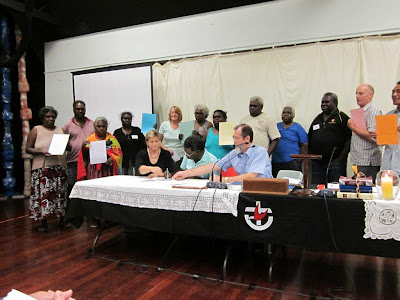 On Monday evening, 27 September 2010, a Memorandum of Understanding regarding the translation of Scriptures into indigenous languages was signed by leaders of AuSIL, the Northern Regional Council of Congress (NRCC – an indigenous presbytery and regional committee of the Uniting Aboriginal and Islander
Christian Congress) and the Uniting Church in Australia Northern Synod. The signing was witnessed by Synod and surrounded by indigenous translators and advisors representing teams from eight languages in Arnhem Land who have recently started working on translation.
The partnership will be carried out through Coordinating Support for Indigenous Scriptures (CSIS), a Uniting Church initiative to support people who are involved in indigenous Scripture and resource work in the ministry areas of the NRCC. For more information see http://www.csis.org.au/_/Welcome.html and http://www.ausil.org.au/
Stories:
The Book in the Bush
by David Strickland
Papunya. Mutitjulu. Titjikala. Irrwelty. Areyonga. Kiwirrkurra. The names roll off the lips after a while, but most Australians have never heard of them. Some of them you would be hard put to find on a map. The names evoke an Aboriginal world that almost seems to operate in parallel to the white Australian world, and can be almost invisible to it. Yet these worlds momentarily mesh together for a meeting of minds and fellowship at the pastors’ training courses, held by the Finke River Mission (FRM).
The names are all places where these courses are held. They are held three times per year, and when you consider that the area covered by these Lutheran communities straddles two states as well as the Northern Territory, you have some idea of the distance travelled to attend the courses, sometimes up to 1500 kilometres. These distances are often beyond the reach of the average sedan car, so those with four-wheel-drive vehicles (including the missionaries) are usually required to pick up people.
The courses are held at bush camps, within easy range of a local community. Usually an area is cleared for this purpose. Having the camp away from the community means that there are fewer distractions to the Bible studies. Holding courses in the bush near where the people live seems far preferable to bringing them to a town like Alice Springs, where there are too many unwelcome distractions.
The course itself may be a study of a book or a wider theme such as parables. A visiting speaker conducts the teaching in English, then the teaching is interpreted in various languages by the missionaries.
The available languages include Pintupi/Luritja, Pitjantjatjara, Western Arrarnta and Alyawarr. Where the translation work has already been done, the Scriptures are read in these languages. More translation is being produced including in Anmatyerr, a new project, and work is continuing in the Alyawarr project. This mode of teaching means that the course moves more slowly, but it also means that everybody should be able to understand what is said. FRM has always had a policy of working in the people’s own languages and translating the Scriptures. This involves a huge investment in time spent in learning the culture and language, but it yields results with pastors and churches established throughout Central Australia.
Imagine having a week’s Bible study in full view of Uluru! Or, in a creek bed fringed by ghost gums! We can often enjoy God’s creation when attending the course, uncluttered by classrooms or desks! Normally we need to find shade, so there is a lot of jockeying for position. We are vulnerable too to wind, rain or dust, so there can be interruptions. Whenever there is rain, people get nervous about driving home on the dirt roads, so it can be a hard job to keep the troops in the barracks!
FRM has an efficient ordinance system perfected after years of practice. A food trailer and a water trailer are brought. The food trailer has a generator and a freezer to keep the food supplies for a week. The local community usually pitches in by providing firewood. There is a cook who lights the fires and cooks vegetables and billies of tea. However the overwhelming preference is for meat, and there is plenty of it! The men cook their own meat on the fires provided.
Some men find the course a bit daunting. They may be reluctant to travel into unknown areas. Tradition and folklore may need to be overcome, or they may just get homesick being away from their homelands. Perhaps they experience ‘culture shock’ or even are convicted by the teaching. Others relish the opportunity to mix with other groups, and one man seems to be known from the West Australian coast right across to Queensland! When camping, they tend to camp and eat with their own group. At night camp fires light up the night sky, especially if it is cold. It is a great opportunity to sit around the fire just chatting with the men, and building up strong friendships. They appreciate it when the missionaries sleep alongside the others, ‘just like one of us.’
During the course of the teaching, issues may arise pertinent to the current life of the churches. These and other church matters may be discussed at a meeting, usually held during an afternoon session. The last course was studying the book of 1 Peter, which has a theme of perseverance under persecution. While there is no state persecution in Australia, the men agreed that they sometimes get ‘pressure’ or ‘persecution’ from their families or community to compromise their faith. Although Aboriginal people appear to be passively listening to the messages, without much comment, these meetings give indication that the teaching is ‘getting through’. The real response is probably best expressed in their love of sing-alongs, held at night and preferably with a full electric band. A Western Desert Gospel band was formed several years ago and has produced several cassettes. They have taken an entourage of a bus and several vehicles on bush tours, recently travelling north as far as Katherine.
You can learn more about the work in Australia by reading their newsletter, http://www.ausil.org.au/Resources/Newsletter/tabid/1100/Default.aspx
An Aboriginal Bible translator concluded: “When we hear the story in English, it does not transform us. But in our own language, God talks directly to us like a close relative.”
Current Needs:
Audio Recordists and Vernacular Media Specialists, Print Publications Manager, Artists including Graphic Design Artists, IT Specialists, Sunday School Curriculum Developer, Linguist/Translators, Office Manager, Finance Manager, Administrative Assistants, Bible School/Seminary Trainer, Scripture Use Workers, Web Master, Events Coordinator, Photo Journalist and more!
Contact me if you'd like more information.
AuSIL signs MOU with Indigenous Presbytery (NRCC)
and Uniting Church in Australia, Northern Synod

Christian Congress) and the Uniting Church in Australia Northern Synod. The signing was witnessed by Synod and surrounded by indigenous translators and advisors representing teams from eight languages in Arnhem Land who have recently started working on translation.
The partnership will be carried out through Coordinating Support for Indigenous Scriptures (CSIS), a Uniting Church initiative to support people who are involved in indigenous Scripture and resource work in the ministry areas of the NRCC. For more information see http://www.csis.org.au/_/Welcome.html and http://www.ausil.org.au/
Stories:
The Book in the Bush
by David Strickland
Papunya. Mutitjulu. Titjikala. Irrwelty. Areyonga. Kiwirrkurra. The names roll off the lips after a while, but most Australians have never heard of them. Some of them you would be hard put to find on a map. The names evoke an Aboriginal world that almost seems to operate in parallel to the white Australian world, and can be almost invisible to it. Yet these worlds momentarily mesh together for a meeting of minds and fellowship at the pastors’ training courses, held by the Finke River Mission (FRM).
The names are all places where these courses are held. They are held three times per year, and when you consider that the area covered by these Lutheran communities straddles two states as well as the Northern Territory, you have some idea of the distance travelled to attend the courses, sometimes up to 1500 kilometres. These distances are often beyond the reach of the average sedan car, so those with four-wheel-drive vehicles (including the missionaries) are usually required to pick up people.
The courses are held at bush camps, within easy range of a local community. Usually an area is cleared for this purpose. Having the camp away from the community means that there are fewer distractions to the Bible studies. Holding courses in the bush near where the people live seems far preferable to bringing them to a town like Alice Springs, where there are too many unwelcome distractions.
The course itself may be a study of a book or a wider theme such as parables. A visiting speaker conducts the teaching in English, then the teaching is interpreted in various languages by the missionaries.
The available languages include Pintupi/Luritja, Pitjantjatjara, Western Arrarnta and Alyawarr. Where the translation work has already been done, the Scriptures are read in these languages. More translation is being produced including in Anmatyerr, a new project, and work is continuing in the Alyawarr project. This mode of teaching means that the course moves more slowly, but it also means that everybody should be able to understand what is said. FRM has always had a policy of working in the people’s own languages and translating the Scriptures. This involves a huge investment in time spent in learning the culture and language, but it yields results with pastors and churches established throughout Central Australia.
Imagine having a week’s Bible study in full view of Uluru! Or, in a creek bed fringed by ghost gums! We can often enjoy God’s creation when attending the course, uncluttered by classrooms or desks! Normally we need to find shade, so there is a lot of jockeying for position. We are vulnerable too to wind, rain or dust, so there can be interruptions. Whenever there is rain, people get nervous about driving home on the dirt roads, so it can be a hard job to keep the troops in the barracks!
FRM has an efficient ordinance system perfected after years of practice. A food trailer and a water trailer are brought. The food trailer has a generator and a freezer to keep the food supplies for a week. The local community usually pitches in by providing firewood. There is a cook who lights the fires and cooks vegetables and billies of tea. However the overwhelming preference is for meat, and there is plenty of it! The men cook their own meat on the fires provided.
Some men find the course a bit daunting. They may be reluctant to travel into unknown areas. Tradition and folklore may need to be overcome, or they may just get homesick being away from their homelands. Perhaps they experience ‘culture shock’ or even are convicted by the teaching. Others relish the opportunity to mix with other groups, and one man seems to be known from the West Australian coast right across to Queensland! When camping, they tend to camp and eat with their own group. At night camp fires light up the night sky, especially if it is cold. It is a great opportunity to sit around the fire just chatting with the men, and building up strong friendships. They appreciate it when the missionaries sleep alongside the others, ‘just like one of us.’
During the course of the teaching, issues may arise pertinent to the current life of the churches. These and other church matters may be discussed at a meeting, usually held during an afternoon session. The last course was studying the book of 1 Peter, which has a theme of perseverance under persecution. While there is no state persecution in Australia, the men agreed that they sometimes get ‘pressure’ or ‘persecution’ from their families or community to compromise their faith. Although Aboriginal people appear to be passively listening to the messages, without much comment, these meetings give indication that the teaching is ‘getting through’. The real response is probably best expressed in their love of sing-alongs, held at night and preferably with a full electric band. A Western Desert Gospel band was formed several years ago and has produced several cassettes. They have taken an entourage of a bus and several vehicles on bush tours, recently travelling north as far as Katherine.
You can learn more about the work in Australia by reading their newsletter, http://www.ausil.org.au/Resources/Newsletter/tabid/1100/Default.aspx
Monday, October 25, 2010
PNG: Stories
Closed Door…Opened Window
by Chad Owens, Dawn Kruger
Arrested because a revival among the people upset the religious leaders.
Three days in an unlocked cell because he promised he would not try to escape.
Reading God’s Word, singing, praying and praising God.
A second revival – this time among the prisoners.
It reads like the biblical story of Paul and Silas but it’s not – it’s the story of Mumure, a gentle pastor living in a small village of Papua New Guinea.
 Mumure Ttopoqogo began working with linguist Ernie Richert because he wanted to learn English. Soon he added Hebrew and Greek to his language repertoire as together the two men translated the New Testament into the Guhu Samane language. News of their work spread throughout the area. By the time they finished the translation, the Guhu Samane people were so anxious for God’s Word that the initial printing of 1200 New Testaments sold out almost immediately and a second printing of 1600 copies sold out in just two weeks. Even those who didn’t read purchased a copy of the Bible to save for their children or grandchildren. The people believed in the power of that Word.
And the Word didn’t disappoint them. Revival broke out. The people turned from witchcraft and previous forms of worship, burning their idols and other spiritual relics. They sang the Psalms back to God in their own language, and even learned to play the guitar to enhance their worship. They used scripture songs as tools for spreading the Word among those who couldn’t read. In fact every verse of the Guhu Samane New Testament and all the Psalms were set to music. They did all this to the glory of God and the consternation of several church leaders, who condemned such practices.
The Guhu Samane people began to embrace even deeper forms of personal worship, and the church leaders became more and more displeased with this new group of believers. When this new, united body of believers began to grow exponentially, the displeased leaders conspired with the police to arrest Mumure and six of his friends, hoping to put an end to what they considered a cult. But prison walls cannot restrain the power of God’s Word.
While in prison, Mumure read aloud from an English Bible, translating the words into Guhu Samane as he read. Fellow prisoners listened to God’s Word in their own language and responded from their heart. Almost immediately, twenty men in that jail gave their lives to Christ and joined Mumure and his friends in singing, praying and praising God.
After three days, a government official came and ordered Mumure and his friends to leave, saying, “You must not go back to your home. Instead, you must go around and preach in all the remote places where we cannot go.” Like the Apostle Paul, Mumure left that prison commissioned by God to preach the Good News to people everywhere; but unlike Paul, Mumure had the blessing of the local government official to do that work.
Soon thousands of people turned to the Christ of the Guhu Samane Bible. Today, 35 years later, this body of believers has sent more than 50 pastors to preach the Good News throughout Papua New Guinea.
The revival never died out: it continues to reach a new generation. The vernacular Psalms and songs are still being sung in churches today. Youth and literacy programs promote the on-going study of the Guhu Samane Scriptures. Mumure and his son Steven have shifted from training pastors to training translators, encouraging Papua New Guineans to assist in translating the Word into other languages of that nation. Their desire is to see more and more people changed by the power of God’s Word in their own language.
Written by Chad Owens & Dawn Kruger
Jesus and the spirits
by Phil Carr
As told by Phil and Chris Carr, linguist-translators working with the Bamu people in PNG.
“You mean … the spirits here know of Jesus!!??”
“Too right they do! And they’re afraid of him!”
“Really?!”
“Yes, they all know him and are afraid of him.”
We sat in silence as Domai tried to take in the enormity of what we’d told her.
She sat there almost dazed, working out the implications and thinking back on her experiences in the past. She’d been a Christian for years, had taught Sunday School for most of that time, and had been a pillar of the area’s only church. For the first time, she began to connect her understanding of Christian teaching with the spiritual realities she had grown up with, of an all-pervasive fear of sorcery and evil spirits.
Why hadn’t she known this before?
Up to now, she had never heard the Scriptures in her own language. All that she and the others had to go on was what they could observe in church meetings, and the little bits of meaning they could squeeze out of the foreign language Bibles* that were occasionally available. So they faithfully copied the ‘church actions’ like singing a few songs and getting someone who could read to read out loud from these foreign Bibles. And she soon realised that being a Christian meant that you were not allowed to drink, smoke or gamble. Then you were a good person, because other people said you were, and that’s what being a Christian was all about really.
But the old beliefs and practices didn’t go away. They weren’t even challenged. Lots of people still went to the church meeting on Sunday, and called out to the spirits to help them catch fish on all the other days without thinking twice about it... Syncretism: Christian form without Christian content.
Now things are starting to change. God’s Word has now started to come into the Bamu language for the first time. Some people are drawing closer and closer to that lamp, and others are trying to hide from it. Plenty of surprises there! But the light has started to shine, because “The unfolding of your words gives light.” Psalm 119:130.
* English and Tok Pisin (Melanesian Pidgin)
"God is a Miniafia Man"
by David Wakefield
“God is a Miniafia Man,” the loincloth-clad speaker exulted! “Before He was English, and American, and Australian. But today He has become Miniafia!”
 A steady beat of drums and trumpeting of conch shells gave voice to the excitement that everyone felt as the 1st of the Miniafia-Oyan New Testaments was carried into the village on a model canoe. Traditionally dressed dancers proceeded and followed the bark cloth wrapped New Testament, their voices thundering praise: “Orokaiwa, Regah Keriso! O a merar ayiy! (Greetings, Lord Christ! We greet You!)”
Walking in front of the “canoe,” Fran and I laughed and cried our way up from the water’s edge, through Utukwaf village, to the especially prepared veranda and speakers’ platform where the Dedication service would take place. We laughed with joy over the obviously enthusiastic reception of the Scripture: 750 copies of the 1000 printed had been purchased before this first had even arrived in the village. We cried in memory of our friends who had died without seeing the Book we were now celebrating. Among them was Utukwaf village chief Gideon Yowen. Not long before he died he said, “My son, you have lived with us now for many years. I love the stories you have translated, but I am now an old man. Soon I will die. My heart is most sad about this: I will never hold the finished Book in my hands.”
The Book that Gideon Yowen died longing for, his children and grandchildren now hold in their hands. It was a day we sometimes despaired of ever seeing. We had begun the project on December 7, 1973, but had to leave it barely half done in 1993. Thanks to the perseverance of national translators Stanley Oyabuwa and Josiah Javeve, translation was finally done and we were able to return to the project and help complete final editing and typesetting early last year.
Miniafia Church leaders, though, were anxious about one thing. “David,” they said. “When you speak, please be sure to let the people know that our work is not finished. As soon as we have rested from this celebration, we need to finish the Old Testament, and we need their continuing support.” Indeed, Stanley Oyabuwa has drafted 70 chapters in Psalms already. He and his wife, Ethyl, have committed to finishing the Old Testament.
Even before the echo of celebrating voices and drumbeats had faded from the air that weekend, the Translation Committee reported that the 900th copy of the New Testament had been sold. “How can we get more?” they asked in alarm. I couldn’t help but smile. What a wonderful problem with which to end a most memorable weekend!
by Chad Owens, Dawn Kruger
Arrested because a revival among the people upset the religious leaders.
Three days in an unlocked cell because he promised he would not try to escape.
Reading God’s Word, singing, praying and praising God.
A second revival – this time among the prisoners.
It reads like the biblical story of Paul and Silas but it’s not – it’s the story of Mumure, a gentle pastor living in a small village of Papua New Guinea.

And the Word didn’t disappoint them. Revival broke out. The people turned from witchcraft and previous forms of worship, burning their idols and other spiritual relics. They sang the Psalms back to God in their own language, and even learned to play the guitar to enhance their worship. They used scripture songs as tools for spreading the Word among those who couldn’t read. In fact every verse of the Guhu Samane New Testament and all the Psalms were set to music. They did all this to the glory of God and the consternation of several church leaders, who condemned such practices.
The Guhu Samane people began to embrace even deeper forms of personal worship, and the church leaders became more and more displeased with this new group of believers. When this new, united body of believers began to grow exponentially, the displeased leaders conspired with the police to arrest Mumure and six of his friends, hoping to put an end to what they considered a cult. But prison walls cannot restrain the power of God’s Word.
While in prison, Mumure read aloud from an English Bible, translating the words into Guhu Samane as he read. Fellow prisoners listened to God’s Word in their own language and responded from their heart. Almost immediately, twenty men in that jail gave their lives to Christ and joined Mumure and his friends in singing, praying and praising God.
After three days, a government official came and ordered Mumure and his friends to leave, saying, “You must not go back to your home. Instead, you must go around and preach in all the remote places where we cannot go.” Like the Apostle Paul, Mumure left that prison commissioned by God to preach the Good News to people everywhere; but unlike Paul, Mumure had the blessing of the local government official to do that work.
 |
| Mumure’s son Steven outside the Translator Training Centre classrooms |
The revival never died out: it continues to reach a new generation. The vernacular Psalms and songs are still being sung in churches today. Youth and literacy programs promote the on-going study of the Guhu Samane Scriptures. Mumure and his son Steven have shifted from training pastors to training translators, encouraging Papua New Guineans to assist in translating the Word into other languages of that nation. Their desire is to see more and more people changed by the power of God’s Word in their own language.
Written by Chad Owens & Dawn Kruger
Jesus and the spirits
by Phil Carr
As told by Phil and Chris Carr, linguist-translators working with the Bamu people in PNG.
“You mean … the spirits here know of Jesus!!??”
“Too right they do! And they’re afraid of him!”
“Really?!”
“Yes, they all know him and are afraid of him.”
We sat in silence as Domai tried to take in the enormity of what we’d told her.
She sat there almost dazed, working out the implications and thinking back on her experiences in the past. She’d been a Christian for years, had taught Sunday School for most of that time, and had been a pillar of the area’s only church. For the first time, she began to connect her understanding of Christian teaching with the spiritual realities she had grown up with, of an all-pervasive fear of sorcery and evil spirits.
Why hadn’t she known this before?
Up to now, she had never heard the Scriptures in her own language. All that she and the others had to go on was what they could observe in church meetings, and the little bits of meaning they could squeeze out of the foreign language Bibles* that were occasionally available. So they faithfully copied the ‘church actions’ like singing a few songs and getting someone who could read to read out loud from these foreign Bibles. And she soon realised that being a Christian meant that you were not allowed to drink, smoke or gamble. Then you were a good person, because other people said you were, and that’s what being a Christian was all about really.
But the old beliefs and practices didn’t go away. They weren’t even challenged. Lots of people still went to the church meeting on Sunday, and called out to the spirits to help them catch fish on all the other days without thinking twice about it... Syncretism: Christian form without Christian content.
Now things are starting to change. God’s Word has now started to come into the Bamu language for the first time. Some people are drawing closer and closer to that lamp, and others are trying to hide from it. Plenty of surprises there! But the light has started to shine, because “The unfolding of your words gives light.” Psalm 119:130.
* English and Tok Pisin (Melanesian Pidgin)
"God is a Miniafia Man"
by David Wakefield
“God is a Miniafia Man,” the loincloth-clad speaker exulted! “Before He was English, and American, and Australian. But today He has become Miniafia!”

Walking in front of the “canoe,” Fran and I laughed and cried our way up from the water’s edge, through Utukwaf village, to the especially prepared veranda and speakers’ platform where the Dedication service would take place. We laughed with joy over the obviously enthusiastic reception of the Scripture: 750 copies of the 1000 printed had been purchased before this first had even arrived in the village. We cried in memory of our friends who had died without seeing the Book we were now celebrating. Among them was Utukwaf village chief Gideon Yowen. Not long before he died he said, “My son, you have lived with us now for many years. I love the stories you have translated, but I am now an old man. Soon I will die. My heart is most sad about this: I will never hold the finished Book in my hands.”
The Book that Gideon Yowen died longing for, his children and grandchildren now hold in their hands. It was a day we sometimes despaired of ever seeing. We had begun the project on December 7, 1973, but had to leave it barely half done in 1993. Thanks to the perseverance of national translators Stanley Oyabuwa and Josiah Javeve, translation was finally done and we were able to return to the project and help complete final editing and typesetting early last year.
Miniafia Church leaders, though, were anxious about one thing. “David,” they said. “When you speak, please be sure to let the people know that our work is not finished. As soon as we have rested from this celebration, we need to finish the Old Testament, and we need their continuing support.” Indeed, Stanley Oyabuwa has drafted 70 chapters in Psalms already. He and his wife, Ethyl, have committed to finishing the Old Testament.
Even before the echo of celebrating voices and drumbeats had faded from the air that weekend, the Translation Committee reported that the 900th copy of the New Testament had been sold. “How can we get more?” they asked in alarm. I couldn’t help but smile. What a wonderful problem with which to end a most memorable weekend!
PNG: Quotes
“In the past the Bible was like a piece of pork wrapped in banana leaves. I tried many ways to explain how good it was, but the people just could not understand. Now, when I read the Book of Jonah in Malinguat, it was like opening the banana leaves. I saw the village people open their eyes wide with big smiles on their faces. Wow! They saw the delicious pork! They wanted to learn more about reading and about the contents of this Book.”
Malinguat Pastor
 “I thought translation was about turning God’s Word into our languages. However, our goal is not translation, but transformation – a tool for taking the Gospel to our people. If people don’t change – our translation is not working.”
Nafian Saremo, Papua New Guinean advisor for the Madi Language Group and translation trainer.
“I have a large family spread throughout the village. If I work for money I can feed them all. But if I translate the Word, it is the best thing I can give them.”
Ismael Samuel, Angaataha Old Testament Translator, and participant in 2010 training courses
“Imagine an old illiterate lady who goes to church and the pastor reads the Bible in English…
Imagine going to a house and they give you one banana, and they ask you to live on that banana for a week… This is what got me interested in translation, not just preaching.”
Ken Andi, Agarabi translator and Ukarumpa translation teaching staff
“We are not well-educated, and we don’t speak English well. But we believe in God, and faith alone will make this work happen. Where we don’t have the knowledge, God provides it.”
Wabele Fuga, Onabasulu, translator and participant in Ukarumpa training course
Malinguat Pastor

Nafian Saremo, Papua New Guinean advisor for the Madi Language Group and translation trainer.
“I have a large family spread throughout the village. If I work for money I can feed them all. But if I translate the Word, it is the best thing I can give them.”
Ismael Samuel, Angaataha Old Testament Translator, and participant in 2010 training courses
“Imagine an old illiterate lady who goes to church and the pastor reads the Bible in English…
Imagine going to a house and they give you one banana, and they ask you to live on that banana for a week… This is what got me interested in translation, not just preaching.”
Ken Andi, Agarabi translator and Ukarumpa translation teaching staff
“We are not well-educated, and we don’t speak English well. But we believe in God, and faith alone will make this work happen. Where we don’t have the knowledge, God provides it.”
Wabele Fuga, Onabasulu, translator and participant in Ukarumpa training course
Subscribe to:
Posts (Atom)